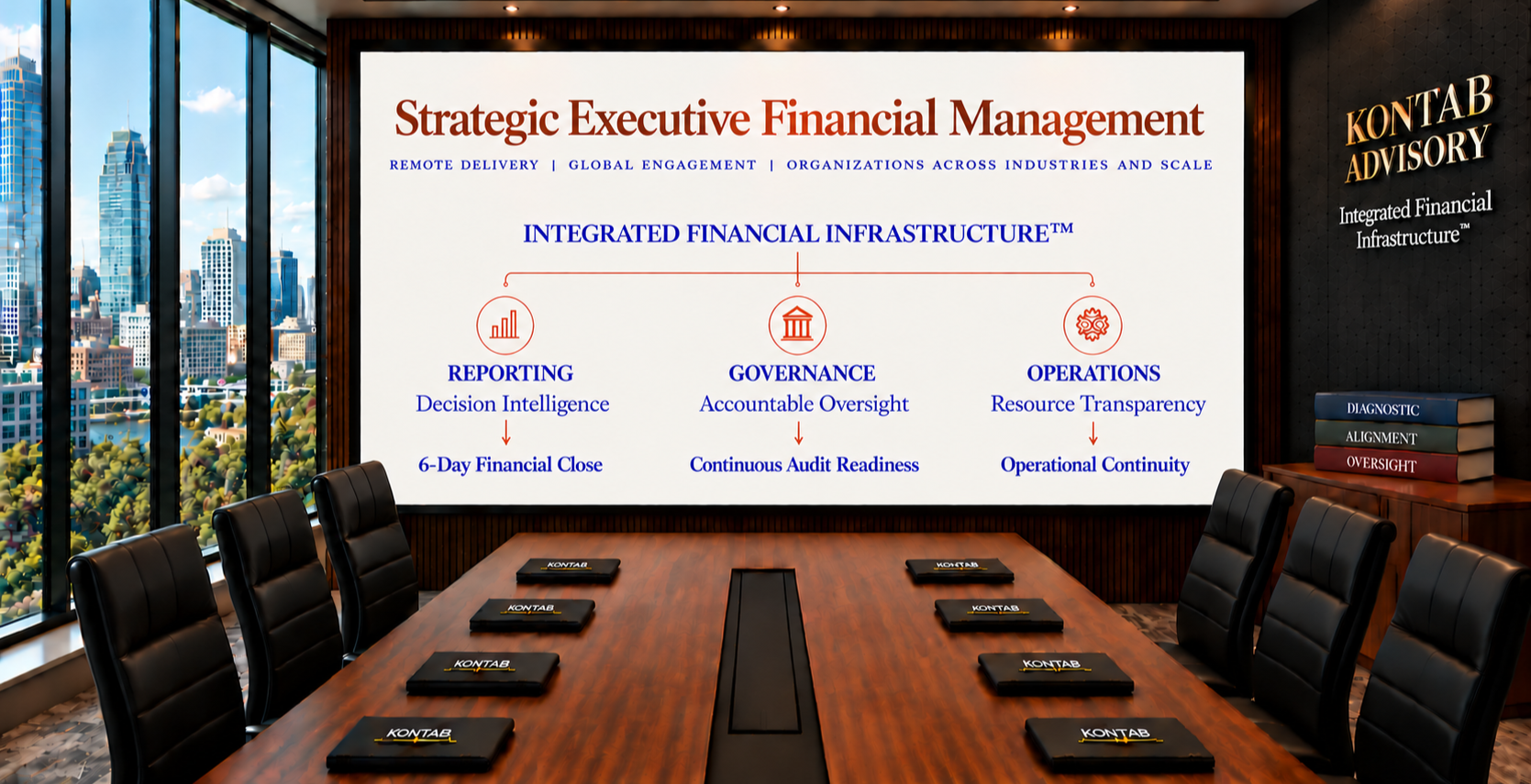
INTEGRATED FINANCIAL INFRASTRUCTURE™
The Path to Financial Infrastructure Maturity.
Organizational requirements determine financial infrastructure.
Integrated Financial Infrastructure™ evaluates, establishes, and sustains the financial environment required by your organization. The methodology progresses through five stages—Awareness, Discussion, Diagnostic, Alignment, and Oversight—connecting preliminary evaluation, verified organizational requirements, structural alignment, and ongoing executive financial management.
01
Financial Infrastructure Awareness
Optional · Complimentary · Under 5 Minutes
ASSESS FINANCIAL INFRASTRUCTURE AWARENESS
Evaluate leadership's understanding of financial infrastructure reliability across reporting, governance, and operations.
Leadership Assessment: Review awareness of current reporting, governance, and operational conditions.
Infrastructure Signals: Identify areas perceived as reliable, unreliable, or uncertain.
Preliminary Insight: Establish a baseline understanding of infrastructure awareness before further evaluation.
DISCUSS FINANCIAL INFRASTRUCTURE ENVIRONMENT
Establish the organizational context necessary to understand the environment in which financial management operates.
Operating Environment: Discuss organizational structure, funding, financial operations, priorities, and current circumstances.
Organizational Context: Review existing teams, systems, responsibilities, stakeholder relationships, and known obligations.
Engagement Determination: Determine whether a Financial Infrastructure Diagnostic is the appropriate next step.
03
Financial Infrastructure Diagnostic
DETERMINE REQUIRED FINANCIAL INFRASTRUCTURE
Establish organizational requirements, evaluate the existing financial environment, and determine the financial infrastructure required.
Organizational Requirements: Review organizational structure, funding arrangements, contractual obligations, stakeholder expectations, operating priorities, and financial management responsibilities.
Infrastructure Evaluation: Assess existing reporting, governance, operations, systems, controls, workflows, and responsibilities against verified organizational requirements.
Verified Findings: Identify structural deficiencies, operational dependencies, risks, and required infrastructure improvements, providing objective recommendations for alignment.
04
Financial Infrastructure Alignment
ESTABLISH REQUIRED FINANCIAL INFRASTRUCTURE
Implement the structural changes identified through diagnostic findings.
Structural Alignment
Establish required financial responsibilities, reporting structures, controls, systems, and workflows.
Functional Integration
Coordinate accounting, transaction processing, treasury management, governance, and executive reporting.
Operational Readiness
Document procedures, establish accountability, and prepare the aligned environment for ongoing financial management.
05
Financial Infrastructure Oversight
SUSTAIN REQUIRED FINANCIAL INFRASTRUCTURE
Sustain financial infrastructure alignment as organizational requirements evolve.
Executive Management
Assume ongoing strategic executive financial management across reporting, governance, and operations.
Continuous Alignment
Maintain financial activities, internal controls, systems, workflows, treasury management, and reporting as organizational requirements change.
Organizational Stewardship
Strengthen operational continuity, sustainable scalability, and accountable management of organizational resources.