Article Description
Controllership establishes financial oversight through accounting review, reporting integrity, internal controls, and accountability for unresolved financial matters. This publication examines Executive Financial Oversight, including financial infrastructure maturity, accounting and close reliability, funding requirements, systems and workflow controls, corrective action, audit readiness, and organizational continuity.
Introduction
Controllership connects accounting quality, financial close discipline, reporting reliability, internal controls, and accountability for unresolved financial matters. A controller-level function may coordinate accounting personnel, review significant judgments and reconciliations, establish reporting procedures, and communicate material deficiencies to authorized leadership. Its responsibilities and authority depend on the engagement and the organization's governance arrangements.
Organizations use controllership services to strengthen financial information, establish consistent accounting review, maintain appropriate controls, and address identified deficiencies. The function may be performed internally, externally, or through shared arrangements among qualified personnel. Responsibilities for preparation, review, approval, escalation, and corrective action must remain clear.
How Does Controllership Differ From Outsourced Accounting and CFO Advisory?
Outsourced accounting emphasizes performing defined accounting activities and maintaining records. Controllership emphasizes the reliability of those activities, reporting integrity, and the effectiveness of related control and review procedures. CFO advisory emphasizes executive financial leadership, resource decisions, and strategic financial direction.
A controller may also supervise accounting execution, coordinate management activities, and contribute to leadership discussions. These interactions do not make the responsibilities interchangeable. The engagement must identify the work and authority actually assigned rather than rely on the service designation alone.
Who Retains Accountability When Controllership Is Outsourced?
Organizational leadership retains institutional decision authority, management responsibilities, and applicable governance obligations. An external controller may perform agreed reviews, recommend procedures, communicate deficiencies, and coordinate corrective action within the engagement's scope and established delegations.
Controllership remains distinct from independent financial statement audits, reviews, attestations, and other assurance engagements. Performing internal review procedures does not establish independent assurance.
This publication examines controllership through Executive Financial Oversight: evaluating whether financial responsibilities operate reliably, evidence supports reported results, and exceptions receive corrective attention. Financial Execution performs activities and maintains records; Financial Management coordinates authority, personnel, systems, and workflows; Financial Leadership interprets conditions for organizational decisions.
These responsibilities operate concurrently across Financial Accounting, Financial Operations, Financial Governance, and Financial Reporting. Outsourced accounting, financial operations, controllership, and CFO advisory represent principal service emphases, not exclusive territories or successive stages.
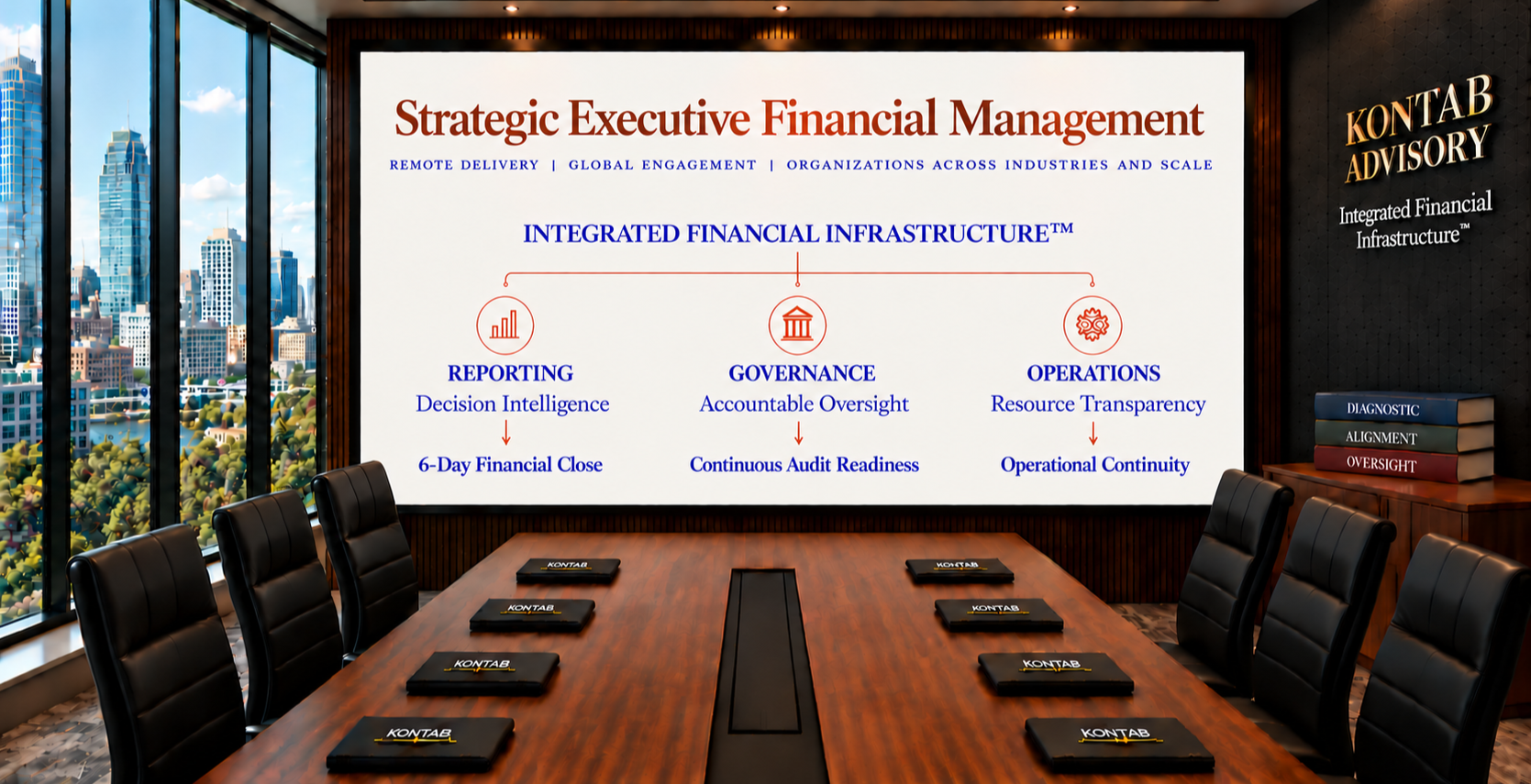
Integrated Financial Infrastructure™ is Kontab Advisory's proprietary coordinating methodology. Diagnose → Align → Sustain describes the professional engagement progression.
Understanding Financial Infrastructure Maturity
Financial infrastructure maturity describes how reliably an organization's financial environment supports its requirements. It is not determined solely by size, staffing, technology, or automation. Evidence may include completed reconciliations, documented reviews, resolved exceptions, dependable reporting, appropriately exercised authority, and continuity through personnel or system changes.
The standard is dependable performance under actual operating conditions, not maximum sophistication. Four contextual conditions can support discussion:
Fragmented: Disconnected processes, inconsistent procedures, and recurring individual intervention.
Developing: Increasing standardization, with incomplete coordination, accountability, or reliability.
Aligned: Coordinated workflows, controls, reporting, and responsibilities with established accountability.
Strategic: Reliable infrastructure supporting forward-looking planning, proactive resource decisions, and sustained executive oversight.
These are interpretive categories, not certified ratings, independently validated scores, or mandatory stages. Different functions may exhibit different conditions: accounting may be dependable while treasury workflows remain vulnerable to absence, or reporting may be timely while funding documentation is inconsistent.
An assessment should identify each material responsibility, evidence of its condition, and the organizational consequences of weaknesses. Additional procedures, software, or personnel should improve reliability or satisfy a verified requirement rather than add complexity without corresponding value.
Evaluating Maturity Without a New Rating Model
Consider an organization using documented manual procedures, timely reconciliations, retained approvals, and consistent exception resolution. Another uses integrated applications but has inconsistent authorizations, unexplained adjustments, and unresolved differences. Technology alone does not establish which environment is more reliable.
Oversight identifies requirements, examines performance, evaluates deficiencies, and establishes responsibility for corrective attention. Descriptive labels may support executive discussion, but they cannot replace evidence or imply guaranteed progression.
Establishing Accounting and Financial Close Reliability
Reliable reporting begins before statements are prepared. Source information must be complete, transactions appropriately recorded, balances reconciled, significant judgments reviewed, and unresolved matters identified. Close coordinates this work through assigned responsibilities, procedures, deadlines, and review.
A controller-level review evaluates what the close package demonstrates and what remains uncertain. Consider supporting schedules, adjustment rationale, consistent policies, unresolved differences, and significant changes from prior periods.
A completed checklist does not establish that underlying procedures were performed appropriately. Signed procedures may lack support for material balances, while an adjustment identified late may be properly documented. Oversight evaluates evidence, significance, timing, and disposition rather than completion dates alone.
Establish the cause of delays before selecting a response. Missing invoices may require better departmental handoffs; recurring differences may require investigation of records or mappings; delayed review may require clarified authority, capacity, or deadlines.
For material or recurring matters, identify the condition, cause, owner, corrective action, completion date, and evidence needed to demonstrate resolution. Examine subsequent periods to determine whether the response worked.
No universal close deadline suits every organization. Evaluate timeliness alongside accounting requirements, reporting reliability, and decision needs. A faster close that omits material procedures is not an improvement; an unusual accounting matter may justify additional evaluation time.
Evaluating a Completed Financial Close
Suppose close is marked complete while a material receivable balance remains unreconciled to its schedule. Review the difference's amount and age, potential statement effects, disclosure of preliminary-report limitations, and ownership of resolution.
If the difference recurs, investigate billing, the ledger interface, and reconciliation procedures. The objective is reliable reporting and correction of the underlying condition, not merely a reviewer signature.
Maintaining Internal Controls and Financial Accountability
Internal controls address risks involving authorization, records, resource protection, compliance, and reporting. Each control needs a defined purpose, assigned responsibility, and evidence of operation. Controls reduce risk exposure but do not eliminate it.
Controllership may contribute to control design, documentation, implementation, and evaluation. A controller may recommend approval limits, segregation of duties, exception reports, and review procedures; authorized leadership approves delegations and retains institutional decision authority.
What Is the Difference Between Control Design and Operating Effectiveness?
Design establishes how a procedure is intended to address risk. Operating effectiveness concerns whether it functioned as required during the relevant period. A policy's existence is not evidence that it was followed.
An approval policy may be ineffective if authorization occurs after payment. A banking access policy may not be implemented when permissions conflict with assigned authority. Oversight compares intended procedures with actual performance.
Distinguish execution, review, approval, and escalation. A payment preparer, documentation reviewer, expenditure approver, and person releasing funds may have different duties. Payment approval and release are separate responsibilities; missing support, unusual amounts, or actions outside delegated authority require defined escalation.
Separate incompatible duties where feasible. Where staffing prevents separation, evaluate suitable supervisory or compensating controls and their limitations. These may include bank-statement review outside the processing workflow, exception reporting, or periodic examination by an authorized individual. The arrangements should reflect actual risks and capacity.
Permissions, delegations, and transaction histories should remain consistent. A mismatch may require action even without financial loss because it shows that practice does not reflect intended accountability.
For missing approvals, unexplained balances, inappropriate access, or recurring failures, identify the affected requirement, significance, owner, immediate response, and follow-up evidence. Repetition may indicate a broader weakness in authority, procedures, capacity, or configuration.
Control Design Versus Operating Effectiveness in Practice
A two-person payment policy establishes the intended control. Evaluating operation requires evidence from actual payments, such as selected transactions, access records, exception logs, and review documentation, using procedures proportionate to risk and obligations.
A deviation may reflect an emergency, unclear delegation, or persistent configuration problem. Assess its circumstances, frequency, exposure, and compensating measures. An internal controllership evaluation is not an independent audit or assurance conclusion.
Monitoring Funding and Compliance Requirements
Grant agreements, donor restrictions, and contracts may establish different expenditure, documentation, authorization, and reporting obligations. Applicable terms and accounting standards determine how activity is identified, recorded, supported, reviewed, and reported.
Connect each agreement to recurring financial work. Assign interpretation of financial requirements, reporting calendars, classifications, expenditure support, allocation review, reconciliation, and exception handling. Shared personnel costs may require allocations grounded in underlying activity and evidence required by applicable terms.
Funding reports may use periods, classifications, or measurement bases different from general-purpose statements. Separate views should remain reconcilable to underlying records. Agreement to the ledger alone is insufficient if documentation is missing, allocations are inappropriate, or classifications conflict with funding conditions.
Oversight evaluates the specific terms governing each resource, including deadlines, allowable-cost requirements where applicable, authorization, records, classifications, and consequences of unresolved matters.
A reporting difference is not automatically noncompliance. Some matters require documentation or correction; others require funder communication, management decisions, or qualified professional advice. Verify applicable terms before determining the response.
Coordinate corrections affecting records, program administration, reports, or commitments. External legal, audit, and tax professionals retain their distinct responsibilities.
Funding Condition Illustration
An expenditure may be properly recognized in accounting while lacking documentation required by a grant. Its accounting treatment may be appropriate even though reimbursement eligibility remains unresolved.
Trace the cost to award terms, authorization, invoice, applicable allocation, and report. The response may involve additional documentation, correction, or specialized guidance. Distinguish confirmed noncompliance from an unresolved interpretation question: neither a balanced ledger nor a favorable budget variance establishes funding compliance.
Evaluating Systems and Workflow Reliability
Information moves through accounting, payroll, banking, expense, funding, and operational systems. Reliability depends on ownership, consistent classifications, valid transfers, appropriate access, and visible exceptions. Automation may reproduce incomplete information or incorrect mappings across many transactions.
Identify material interface owners and authoritative sources. Evaluate mappings for accounts, programs, funding dimensions, and entities. Missing records, duplicates, rejected imports, and incorrect classifications require assigned monitoring, investigation, and reconciliation.
Changes to configurations, permissions, reporting dimensions, or account structures may require approval, testing, and subsequent review. Before automation, define activities, inputs, outputs, authorizations, validation, exceptions, and maintenance.
Testing should cover representative transactions, unusual conditions, failures, and recovery. Evaluate error rates, exception volumes, differences, correction effort, and maintenance, not processing speed alone.
Automation can reduce dependence on operators while increasing reliance on configurations, interfaces, and technical personnel. Controlled manual procedures may remain appropriate when assigned, documented, reviewed, and reliable. Critical activities also need suitable fallback arrangements.
Trace selected information from origin through transfer, processing, accounting, reporting, and review. Successful implementation does not establish continuing reliability: configuration changes, turnover, reporting demands, and new activities may alter dependencies. Periodic oversight evaluates whether failures remain detectable and are resolved.
Integration Exception Illustration
Suppose payroll transfers automatically into the ledger. Evaluate reconciliation of source and destination control totals and whether failures generate actionable exceptions. A successful import notice does not establish correct inclusion of every employee, liability, or allocation.
A mapping error may affect several periods before discovery. Review change authorization, permissions, reconciliation, and traceability through final reporting. Reliability is demonstrated through controlled outputs and resolved exceptions, not automation alone.
Establishing Continuing Financial Oversight
Oversight requires recurring evaluation at intervals appropriate to significance and the time available for corrective action. Transaction exceptions may require prompt attention; reconciliations and close follow reporting schedules; systems, authority, responsibilities, and policies may need periodic or change-triggered review.
Identify required information, preparers, reviewers, unresolved matters, potential decisions, and escalation triggers. Meetings and status reports do not establish oversight unless material observations lead to assigned actions, documented responses, and verification.
An exception register should identify:
The condition observed.
The applicable requirement or control.
Potential significance or exposure.
The responsible owner.
Immediate containment measures.
Required corrective action.
Expected completion date.
Evidence needed to verify resolution.
Final disposition and subsequent review results.
The register should support accountable follow-up rather than accumulate unresolved observations. Distinguish containment from lasting correction: additional manual payment review may reduce exposure while a defective authorization workflow is repaired, but it does not resolve the underlying defect.
Verify whether interim measures operated, permanent corrections were implemented, and revised processes perform reliably. Do not close an action solely on an owner's report of completion. Recurring failure after closure requires reconsideration of the remedy or implementation.
Distinguish routine corrections from matters requiring executive or governing-body authority. Oversight presents evidence, uncertainty, and escalation needs; authorized leadership determines consequential responses.
Corrective Action Verification
For recurring late reconciliations, a plan may assign a new preparer, revise input deadlines, and establish a reviewer outside preparation. Examine subsequent periods for timeliness, adequate support, and unexplained carryforward differences.
If timeliness improves but unsupported balances persist, correction remains incomplete. Preserve the finding, exposure, owner, due date, interim measure, remediation evidence, and verification result. Closure should reflect demonstrated performance, not simply completion of a project task.
Maintaining Audit Readiness
Audit readiness depends on available records, reconciliations, schedules, explanations, approvals, and significant accounting judgments. Ordinary financial management should maintain these throughout the year rather than reconstruct them solely for external examination.
Controllership may coordinate auditor requests, identify documentation gaps, reconcile support, assign responses, and monitor outstanding items. These activities support an external engagement but do not constitute independent assurance.
How Does Controllership Support Audit Readiness?
Controllership establishes and evaluates how information is prepared, reviewed, documented, retained, and made available for examination. Assign ownership of material reconciliations, schedules, transaction evidence, policies, judgments, and relevant agreements. Records should explain the underlying activity and treatment.
For an audit or review, establish request owners, deadlines, communication, and unresolved-item tracking. The financial management team may prepare agreed schedules, explain procedures, reconcile records, and coordinate responses within scope.
Management retains responsibility for information, representations, and institutional decisions. Independent auditors retain responsibility for procedures, findings, conclusions, and opinions under the standards governing their engagement.
Readiness does not guarantee an unmodified opinion, absence of findings, or any particular result. It also differs from due diligence, legal analysis, valuation, and other specialized services.
Evaluate whether information is retrievable, balances are supported, limitations are accurately communicated, and representations rest on available evidence. Repeated last-minute reconstruction may indicate a persistent weakness even when the audit is completed.
Audit Readiness Boundary
A fixed-asset schedule should be supported by a retrievable rollforward, invoices, depreciation calculations, and reconciliation to the ledger, without reconstructing the entire history at year-end. This supports external examination but does not determine audit procedures, findings, or opinions.
Auditors may identify matters not previously detected internally. Controllership should communicate known limitations accurately while preserving external assurance providers' independence.
Sustaining Financial Infrastructure Maturity
Infrastructure drift occurs when responsibilities, procedures, systems, or controls no longer reflect actual activity and obligations. Documentation may lag reassigned duties, reports may need increasing adjustments, exceptions may become routine, or new programs may operate outside established processes.
Investigate rather than restructure automatically. Compare practice with the intended arrangement, identify changes and their authorization, and evaluate whether controls remain suitable. Increasing effort to produce the same information may reveal dependencies before deadlines are missed.
New programs, funding, entities, leadership, or systems may require targeted revisions to records, permissions, controls, and reporting. Preserve effective arrangements; identify approved modifications, implementation owners, documentation updates, and verification evidence where changes are needed.
Confirm performance after implementation. Revised reconciliation procedures matter when subsequent accounts are supported and exceptions resolved; approval redesign matters when transactions follow the authorized sequence; reporting technology matters when information remains accurate, traceable, and useful.
An arrangement reliable under earlier conditions may become insufficient as requirements or volumes change. Oversight supplies evidence for Management to adjust operations and Leadership to assess limitations. It supports, but does not replace, institutional judgment.
Sustaining Oversight Through Change
After a migration or leadership transition, reevaluate permissions, approval sequences, and report definitions. A targeted review can examine representative transactions, reconciliations, outputs, and exception resolution under the revised arrangement.
Findings inform Management's corrective coordination and Leadership's assessment of commitments. Maturity is sustained through demonstrated performance as conditions evolve, not preservation of an earlier favorable assessment.
Conclusion
Controllership provides a continuing basis for evaluating financial reliability, reporting integrity, controls, and accountability for unresolved matters. Executive Financial Oversight examines whether responsibilities operate as intended, evidence supports reported completion, and significant exceptions receive corrective attention.
Its effectiveness depends on documented review, meaningful escalation, verified correction, and evaluation as requirements change. Oversight operates alongside Execution, Management, and Leadership across Financial Accounting, Financial Operations, Financial Governance, and Financial Reporting.
When these responsibilities remain coordinated, controllership strengthens financial integrity, accountable oversight, and organizational continuity while preserving institutional decision authority and external assurance independence.
About Kontab Advisory
Kontab Advisory is a strategic executive financial management consultancy serving organizations across industries, disciplines, and scale. Integrated Financial Infrastructure™ is Kontab Advisory's proprietary methodology for coordinating financial reporting, governance, operations, and accounting across financial leadership, oversight, management, and execution.
The methodology aligns professional capabilities, systems, workflows, and accountability arrangements with organizational requirements to support organizational continuity.
Integrity by Design, Excellence by Standard.
This publication is intended for professional education and executive understanding. It does not constitute an independent audit, attestation, legal opinion, tax opinion, or organization-specific professional engagement.