Executive Leadership
REPORTING · GOVERNANCE · OPERATIONS
15+
YEARS EXPERIENCE
$100M+
FINANCIAL OVERSIGHT
One Partner
INTEGRATED FINANCIAL INFRASTRUCTURE™
KONTAB ADVISORY
A Strategic Executive Financial Management Partner for Organizational Stewardship.
Kontab Advisory is a strategic executive financial management consultancy providing remote, full-service financial management to organizations across industries, scale, and borders.
We partner with nonprofits, associations, foundations, government entities, contractors, and corporations seeking stronger financial stewardship or navigating growth, leadership transitions, complex funding, distributed operations, and evolving requirements.
Kontab Advisory unites outsourced accounting, controller oversight, CFO advisory, and financial operations consulting into a single executive partnership. Working directly with organizational leadership, we coordinate financial execution across personnel, systems, and stakeholders while reinforcing internal capacity—establishing scope through verified organizational requirements rather than predetermined packages, hourly billing, or fractional allocations.
LEADERSHIP BEHIND THE FIRM
Managing Financial Infrastructure, Not Just Capacity.
Syndia Alexandre | Founder & Chief Executive Officer
Founded and led by Syndia Alexandre, Kontab Advisory draws on more than 15 years of financial management experience and over $100 million in financial oversight across nonprofit, corporate, technology, education, and public accounting environments.
Her experience spans accounting, reporting, planning, treasury management, internal controls, compliance, and executive oversight across multi-program, distributed, and transitional operations. This work revealed a recurring structural gap: organizational requirements frequently evolve faster than the financial infrastructure supporting them.
Kontab Advisory was founded to close that gap—establishing and sustaining the financial environment required for reliable decision-making, accountable governance, and operational continuity.


STRATEGIC EXECUTIVE FINANCIAL MANAGEMENT
Organizational Requirements Determine Financial Infrastructure.
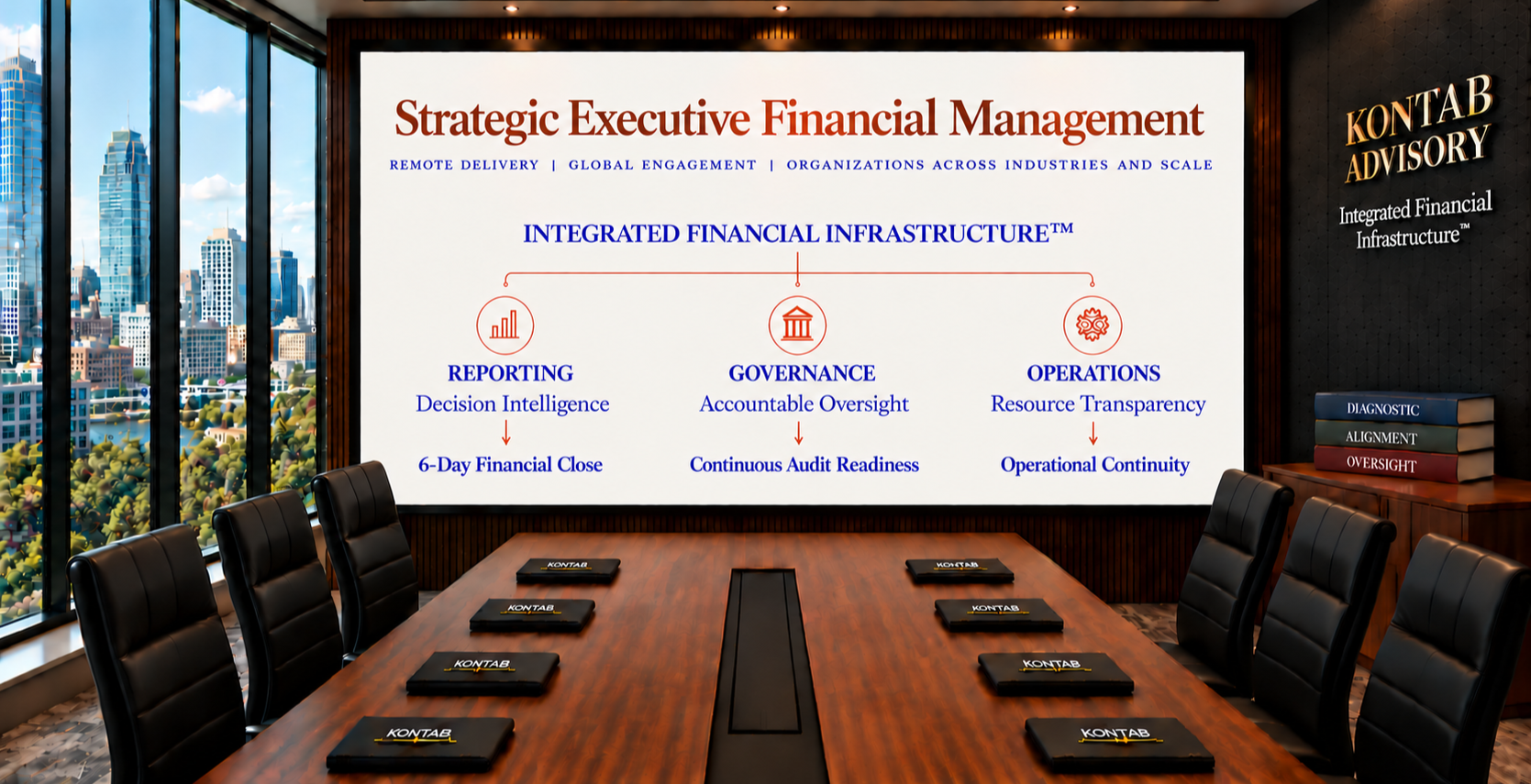
Integrated Financial Infrastructure™ is Kontab Advisory’s proprietary methodology for aligning financial management responsibilities with the systems, workflows, controls, reporting structures, and executive oversight required to sustain them.
It connects financial execution, resource planning, governance, and leadership within one coordinated environment—uniting bookkeeping, accounting, reporting, budgeting, forecasting, treasury management, internal controls, financial operations, and CFO leadership within one ongoing executive partnership.
The objective is not simply to consolidate tasks, add temporary capacity, or implement software. It is to establish the financial infrastructure the organization requires and sustain its alignment as requirements evolve.
Reporting
-
Accounting & Close
Bookkeeping, general ledger management, reconciliations, financial close, financial statements, management reporting, and supporting schedules.Planning & Forecasting
Organizational and program budgets, financial projections, scenario analysis, cash-flow forecasts, and budget-to-actual analysis.Financial Analysis
Performance evaluation, cost and margin analysis, liquidity assessment, and resource allocation insights.CFO Leadership
Strategic financial guidance, executive and board reporting, financial risk evaluation, and decision support aligned with organizational priorities.
Information Asymmetry → Decision Intelligence
Disconnected data, delayed reconciliations, and inconsistent reporting obscure financial performance. Coordinated accounting, close, planning, and analysis replace fragmented outputs with dependable information and clearer executive visibility.
Illustrative impact: A complex multi-program environment reduced its monthly financial close from 45 days to six days.
Governance
-
Executive Oversight
Controller oversight, reporting integrity, performance monitoring, and coordination of financial responsibilities with organizational priorities.Internal Controls
Accounting policies, approval authority, segregation of duties, documented responsibilities, and consistently applied financial controls.Audit & Tax Coordination
Maintained records, schedules, and documentation supporting ongoing audit readiness; external-auditor coordination; and tax preparation within applicable engagements, with tax-professional coordination when required.Funding Accountability
Grant tracking, restricted-funding oversight, cost allocation, and financial reporting and controls aligned with applicable funding, contractual, and organizational obligations.
Unclear Accountability → Accountable Oversight
Ambiguous authority, informal controls, and inconsistent policies weaken accountability. Defined responsibilities, approval structures, and audit-readiness practices establish more disciplined financial oversight.
Illustrative impact: A complex distributed environment transitioned from episodic financial intervention to defined accountability and structured oversight.
Operations
-
Transaction Management
Accounts payable, accounts receivable, payment processing, collections coordination, payroll coordination, and daily transaction execution.Treasury Management
Cash positioning, liquidity monitoring, banking coordination, funding availability, and treasury workflows.Systems Alignment
Evaluation and alignment of financial technology, system requirements, data flows, integrations, and workflow compatibility.Workflow Continuity
Process standardization, documented procedures, defined responsibilities, and coordinated handoffs that reduce personnel dependency and manual workarounds.
Personnel Dependency → Resource Transparency
Concentrated knowledge, fragmented workflows, and disconnected systems create administrative friction and operational dependencies. Coordinated execution and documented procedures improve visibility into resources and obligations while strengthening continuity.
Illustrative impact: A complex multi-project environment expanded from five to 30 projects without additional administrative overhead.
Illustrative impacts reflect prior professional experience across complex organizational environments. Results vary according to organizational requirements, starting conditions, and implementation circumstances.
ENGAGEMENT PATHWAY
Start With Awareness. Begin With a Discussion. Proceed With Clarity.
Begin with an optional assessment or a complimentary discussion. A formal Diagnostic establishes verified requirements, followed by an ongoing executive partnership that aligns and manages the financial environment your organization needs.
01
DISCOVER
Financial Infrastructure Awareness
Leadership explores organizational priorities, develops preliminary awareness, and determines whether to proceed.
Explore operating priorities, identify vulnerabilities, and determine next steps.
Leadership Awareness
The optional, complimentary Financial Infrastructure Awareness assessment captures leadership’s perspective on reporting, governance, and operations—highlighting areas perceived as reliable, inconsistent, or uncertain.
Complete Assessment →
Organizational Context
The complimentary 60-minute Financial Infrastructure Discussion explores operating priorities, funding structures, workflows, systems, responsibilities, and known obligations.
Schedule Discussion →
Next-Step Determination
Consider whether a formal Diagnostic is warranted. Preliminary insights inform the discussion; they do not constitute verified findings.
02
DETERMINE
Financial Infrastructure Diagnostic
Diagnostic establishes verified requirements, identifies structural deficiencies, and determines the engagement scope.
Establish verified organizational requirements and determine whether the existing financial environment supports them.
Requirements Verification
Examine organizational structure, funding arrangements, contractual obligations, stakeholder expectations, operating priorities, and financial responsibilities.
Infrastructure Evaluation
Assess reporting, governance, operations, systems, internal controls, and workflows to identify structural gaps, risks, bottlenecks, and personnel dependencies.
Findings & Scope
Establish evidence-based recommendations and infrastructure priorities that inform the implementation roadmap, engagement scope, and investment.
03
ESTABLISH
Financial Infrastructure Alignment
Kontab Advisory establishes the required financial infrastructure and assumes ongoing responsibility for its execution, alignment, and oversight.
Establish the required infrastructure and sustain it through ongoing executive financial management.
Structural Alignment
Implement Diagnostic recommendations by aligning responsibilities, approval authority, controls, systems, and documented workflows within one coordinated financial environment.
Financial Execution
Manage required accounting, close, planning, treasury, and transaction responsibilities, with defined accountability and coordinated executive and stakeholder reporting.
Continuous Oversight
Provide executive financial leadership, board reporting, external-auditor coordination, and ongoing infrastructure alignment as organizational priorities, funding, obligations, and operations evolve.
Together, these functions and stages connect financial activity to reliable intelligence, information to accountable oversight, and coordinated execution to operational continuity. Infrastructure maturity precedes scalability.
FINANCIAL MANAGEMENT, INTEGRATED
Organizational Economic Impact.
TRADITIONAL INTERNAL FINANCE
Finance leadership
Controller & accounting management
Senior & staff accounting capacity
AP/AR, Payroll & transactional capacity
Recruiting & turnover exposure
Payroll taxes & employee benefits
Organizational Investment
INTEGRATED FINANCIAL INFRASTRUCTURE™
Integrated
Integrated
Integrated
Integrated
Reduced dependency on internal finance staffing
Potential reduction in internal finance payroll costs
Starts at $5,000/month
Responsibilities and potential staffing efficiencies depend on verified organizational requirements and the agreed engagement scope.
INTEGRITY BY DESIGN, EXCELLENCE BY STANDARD
Integrated Capability. Executive Accountability. Organizational Continuity.
-
Financial execution connected to executive accountability.
Financial Execution
Bookkeeping, accounting, reconciliations, financial close, management reporting, and daily financial operations.Planning & Resources
Budgeting, forecasting, financial analysis, liquidity monitoring, cash-flow planning, and treasury management.Executive Leadership
Controller oversight, strategic financial guidance, risk evaluation, and executive and board decision support.Unified Accountability
Defined responsibilities, documented workflows, and structured coordination connect daily execution with governance and leadership decisions.
-
Verified needs determine scope, investment, and delivery.
Preliminary Assessment
An optional, complimentary Financial Infrastructure Awareness assessment provides a starting point for considering the organization’s financial environment.Initial Discussion
A complimentary Financial Infrastructure Discussion of up to 60 minutes explores priorities, operating concerns, and appropriate next steps.Scope & Investment
Full-service, ongoing engagements start at $5,000 per month, with scope and pricing determined by verified requirements—not predetermined packages, hourly blocks, or fractional allocations.Delivery & Access
A remote executive partnership combines direct executive access, structured coordination, and leadership meetings at least weekly.
-
Evaluate the environment. Establish requirements. Sustain alignment.
Environment Evaluation
Assess existing responsibilities, systems, workflows, reporting structures, and internal controls before recommending technology changes, automation, or operational adjustments.Financial Infrastructure Diagnostic
Identify structural gaps, operational dependencies, and required infrastructure maturity. Verified findings inform recommendations, engagement scope, and investment.Financial Infrastructure Alignment
Establish and align responsibilities, workflows, systems, reporting structures, and internal controls according to Diagnostic findings.Financial Infrastructure Oversight
Sustain alignment through ongoing strategic executive financial management as organizational requirements evolve.
-
Experienced leadership. Defined responsibilities. Clear boundaries.
Executive Experience
Founded and led by Syndia Alexandre, Kontab Advisory draws on more than 15 years of executive financial management experience and over $100 million in financial oversight.Operating Experience
Experience spans nonprofit, corporate, technology, education, and public accounting environments—including multi-entity, multi-program, distributed, and transitional operations with complex funding sources.Professional Boundaries
Kontab Advisory maintains confidentiality and supports audit readiness and external-auditor coordination. We do not perform independent financial statement audits, reviews, or attestations. Tax preparation is integrated into applicable ongoing engagements; standalone tax services are not offered.Institutional Identity
Maryland-based LLC serving organizations across industries, scale, and borders.
NAICS: 541611 & 541219
Unique Entity ID: TGV3TAXNVVH3
CAGE Code: 25UX9